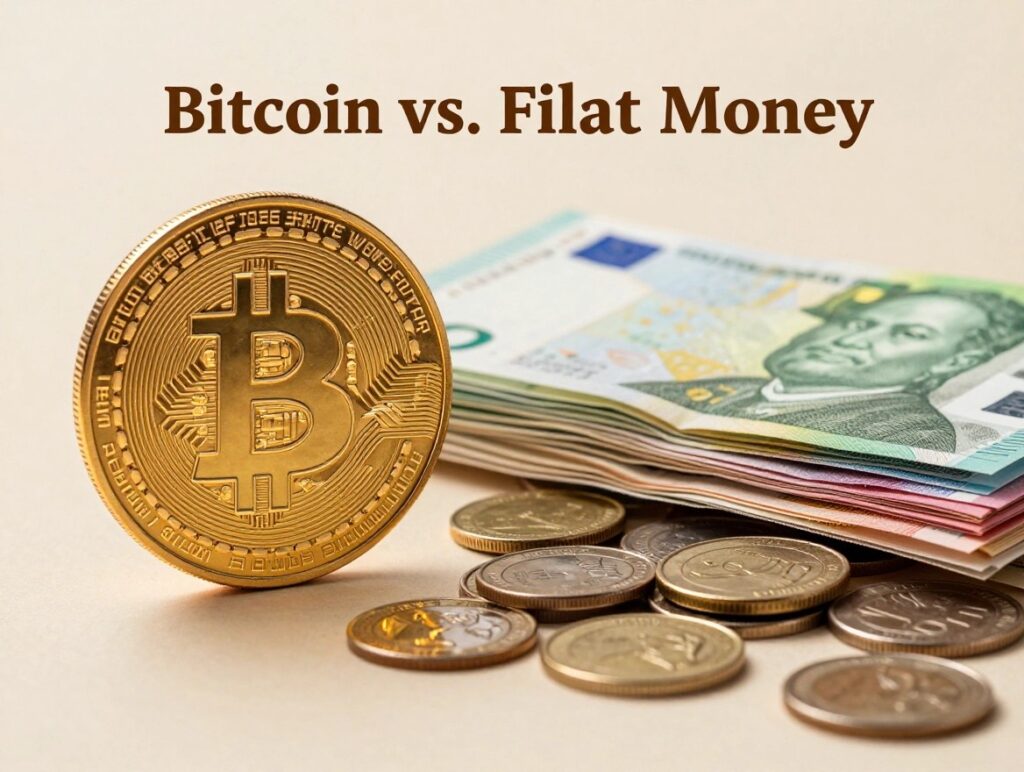
Bitcoin and fiat currencies both play important roles in today’s financial world — but in entirely different ways. While fiat currencies such as USD, EUR, or GBP are issued and controlled by governments, Bitcoin was created as a decentralized alternative that operates independently of traditional financial institutions.
In this article, we compare the key features, advantages, and drawbacks of Bitcoin and fiat money.
What Is Fiat Money?
Fiat money is the type of currency we use every day. Its value is backed by government authority rather than a physical commodity like gold.
Key characteristics:
- Issued and controlled by governments or central banks
- Not backed by gold or any physical asset
- Supply can be increased at any time
- Recognized as legal tender
Fiat money is stable, widely accepted, and supported by regulatory frameworks — but suffers from long-term inflation and loss of purchasing power.
What Is Bitcoin?
Bitcoin is a decentralized digital currency created in 2009 by the pseudonymous Satoshi Nakamoto. It runs on blockchain technology and operates without a central authority.
Bitcoin’s core features:
- No central control
- Fixed maximum supply of 21 million BTC
- Transactions are verified by a global network of computers
- Borderless, peer-to-peer payments
- Transparent, immutable ledger (blockchain)
Bitcoin is often referred to as “digital gold” because of its scarcity and deflationary nature.
Key Differences Between Bitcoin and Fiat Money
1. Centralization vs. Decentralization
- Fiat: Controlled by states, banks, and monetary authorities.
- Bitcoin: Governed by decentralized consensus — no single entity controls it.
2. Money Supply
- Fiat: Unlimited; central banks can print more at will.
- Bitcoin: Hard-capped at 21 million; deflationary asset.
3. Inflation
- Fiat: Loses value over time due to inflation.
- Bitcoin: Designed to resist inflation thanks to limited supply and halving events.
4. Speed and Cost of Transactions
- Fiat: Bank transfers can be slow and expensive, especially across borders.
- Bitcoin: Operates 24/7; fees and speed depend on network conditions. Lightning Network allows instant micro-transactions.
5. Privacy
- Fiat: Banks have full visibility of your financial activity.
- Bitcoin: Pseudonymous — transactions use wallet addresses, not names.
6. Security
- Fiat: Security depends on the stability of the nation and banking system.
- Bitcoin: Extremely secure due to massive computational power, but self-custody requires user responsibility.
7. Adoption and Usability
- Fiat: Universally accepted.
- Bitcoin: Acceptance is growing but still not universal.
Pros of Bitcoin
- Fixed supply – protection against inflation
- Decentralized – no government control
- Global access, no borders
- Censorship resistance
- Transparent and immutable ledger
- Enables self-custody and financial sovereignty
Cons of Bitcoin
- High price volatility
- Requires technical understanding
- Loss of seed phrase = loss of funds
- Not accepted everywhere
- Regulatory uncertainty in some countries
Pros of Fiat Money
- Stable and low-volatility
- Easy to use
- Backed by government and legal systems
- Universally accepted
- Deposits may be insured
Cons of Fiat Money
- Unlimited money printing leads to inflation
- Declining long-term purchasing power
- Centralized control
- Banks can freeze accounts or deny payments
- Slow and expensive cross-border transfers
Bitcoin or Fiat? Which Is Better?
It depends on what you need:
For everyday payments:
Fiat remains more practical due to universal acceptance.
For long-term store of value:
Bitcoin offers advantages fiat cannot match — especially scarcity.
For financial freedom and censorship resistance:
Bitcoin is the stronger choice thanks to decentralization.
Conclusion
Bitcoin and fiat currencies are not enemies — they simply serve different purposes. Fiat money remains the dominant medium of exchange, while Bitcoin is increasingly seen as a powerful store of value and an alternative financial system.
The future will likely combine both worlds: traditional finance alongside decentralized digital assets.